Code
using Pkg
Pkg.add("Plots")The effective axion-photon lagrangian can be written as: \mathcal{L}_{\alpha\gamma} = (\frac{1}{2} \partial_\mu a \, \partial^\mu a - \frac{1}{2}m^2 a^2) + (-\frac{1}{4} F_{\mu\nu} F^{\mu\nu}) - \frac{1}{4} g \, a \, F_{\mu\nu} \tilde{F}^{\mu\nu} Here \tilde{F}^{\mu\nu} = \frac{1}{2}\epsilon^{\mu\nu\rho\sigma}F_{\rho\sigma} is the dual of F^{\mu\nu}. Focus on the interaction term, break F^{\mu\nu} out, we have: \begin{align*} -\frac{1}{4} g \, a \, F_{\mu\nu} \tilde{F}^{\mu\nu} &= -\frac{1}{8} g \, a (\partial_\mu A_\nu - \partial_\nu A_\mu) \epsilon^{\mu\nu\rho\sigma} (\partial_\rho A_\sigma - \partial_\sigma A_\rho) \\ &= - \frac{1}{2} g \, a \epsilon^{\mu\nu\rho\sigma} \partial_\mu A^\nu \partial_\rho A^\sigma \end{align*} Then we get the interaction vertex in the form of (in momentum space): i g \epsilon^{\mu\nu\rho\sigma} k^{(1)}_\mu k^{(2)}_\rho Here k^{(1,2)} are the momentum of incoming and outcoming photons, amoung k^{(1)} and k^{(2)}, one flows into the vertex and and the other one flows out. Now recall the propagator of scalar particles and photons, we have:
For the lowest order of photon-axion Compton-like scattering, only two Feynman diagrams contribute, one s-channel and one u-channel:
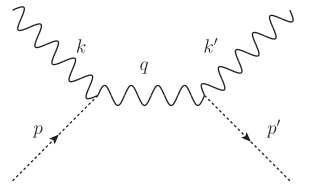

and we can write: \begin{align*} i\mathcal{M}_s &= \epsilon^{\gamma}_{\nu}(k) \left( i g \epsilon^{\mu\nu\alpha\beta} k_\mu (k+p)_\alpha \right) \frac{i \eta_{\beta\lambda}}{(k+p)^2} \left( i g \epsilon^{\delta\lambda\rho\sigma} (k'+p')_\delta k'_\rho \right) \epsilon^{\gamma'}_{\sigma}(k') \\ \mathcal{M}_s &= - \frac{g^2}{(k+p)^2} \epsilon^{\gamma}_{\nu}(k) \epsilon^{\mu\nu\alpha\beta} k_\mu p_\alpha \eta_{\beta\lambda} \epsilon^{\delta\lambda\rho\sigma} p'_\delta k'_\rho \epsilon^{\gamma'}_{\sigma}(k') \end{align*} along with: \begin{align*} i\mathcal{M}_u &= \epsilon^{\gamma}_{\nu}(k) \left( i g \epsilon^{\mu\nu\alpha\beta} k_\mu (k-p')_\alpha \right) \frac{i \eta_{\beta\lambda}}{(k-p')^2} \left( i g \epsilon^{\delta\lambda\rho\sigma} (k'-p)_\delta k'_\rho \right) \epsilon^{\gamma'}_{\sigma}(k') \\ \mathcal{M}_u &= - \frac{g^2}{(k-p')^2} \epsilon^{\gamma}_{\nu}(k) \epsilon^{\mu\nu\alpha\beta} k_\mu p'_\alpha \eta_{\beta\lambda} \epsilon^{\delta\lambda\rho\sigma} p_\delta k'_\rho \epsilon^{\gamma'}_{\sigma}(k') \end{align*} Then the total scattering amplitude is: \begin{align*} \mathcal{M} &= \mathcal{M}_s + \mathcal{M}_u \\ &= - g^2 \epsilon^{\gamma}_{\nu}(k) k_{\mu} \left( \frac{p_\alpha p'_\delta}{(k+p)^2} + \frac{p'_\alpha p_\delta}{(k-p')^2} \right) k'_{\rho} \epsilon^{\gamma'}_{\sigma} (\epsilon^{\beta\mu\nu\alpha} \eta_{\beta\lambda} \epsilon^{\lambda\delta\rho\sigma}) \end{align*} Contract and simplify this impossible expression by FORM script and complete spin sum, we can finally get: \left| \mathcal{M} \right|^2_{all} = g^4 \left\{ \frac{m^8}{16}(\frac{1}{s} + \frac{1}{u})^2 - \frac{m^4}{8}(\frac{u}{s} + \frac{s}{u} - 6) - m^2 (s + u) + \frac{5}{16}(s + u)^2 \right\} This result is completely symmetric between s and u. And, at the limit of k \to 0, \left| \mathcal{M} \right|^2_{all} = 0, which is correct since the interaction vertex is proportional to photon momentum.
To understand this result more intuitively, we can draw some diagrams using julia:
using Pkg
Pkg.add("Plots")using Plots
const m = 1e-4::Float64
function dot_p(x, y)
prod = - x[1] * y[1] + sum([x[n] * y[n] for n in 2:4])
return prod
end
function get_M2(s, u)
m2 = + m^8 / 16 * (1/s + 1/u)^2 -
m^4 / 8 * (u/s + s/u - 6) -
m^2 * (s + u) +
5 / 16 * (s + u)^2
return m2
end
function get_εp(ε, θ)
εp = ε * m / (m + ε * (1 - cos(θ)))
return εp
end
function get_M2s(ε, θs)
M2s = Vector{Float64}(undef, length(θs))
Threads.@threads for i in 1:length(θs)
θ = θs[i]
εp = get_εp(ε, θ)
s = 2 * ε * m + m^2
u = - 2 * εp * m + m^2
M2s[i] = get_M2(s, u)
end
return M2s
end
θs = 0:1e-4:π
ε1 = 1e-5
M2s1 = get_M2s(ε1, θs)
ε2 = 1e-4
M2s2 = get_M2s(ε2, θs)
#ε3 = 1e-1
#M2s3 = get_M2s(ε3, θs)
display(plot(θs, M2s1, legend=false))
display(plot(θs, M2s2, legend=false))
#display(plot(θs, M2s3, lengend=false))

Something interesting is happening. When \varepsilon >= m_a/2, there will always be a “peak” (infinite pole) in our scattering amplitude. This is actually because the axion can decay into 2 photons, and for an on-shell photon, it can travel for infinitely long time before interaction with another photon, which makes our scattering amplitude infinite. If we want to integral over \theta to get total cross-section, we need to omit a small region around where the singularity appears.