Born approximation is one of the most well-known perturbation method for calculating quantum scattering processes in quantum mechanics. The transition matrix can be written as: \bra{p'} i \hat{T} \ket{p} = -i \tilde{V}(\bm{q}) (2 \pi) \, \delta( E_{p'} - E_p ) where \bm{q} = \bm{p'} - \bm{p}.
Surely this result can be acquired though “canonical” quantum mechanics manner, but using path integral can be super easy to get this result in a very intuitive way.
Say, the Hamitonian of incident particle is: H = {p^2 \over 2m} + V(x). Then immediately we can write down the Lagrangian: L = {1 \over 2} m \dot{x}^2 - V(x) Just a simple transform.
Recall the definition of propagator: \begin{align*} K &= \int_{x(-T/2)={x_i}}^{x(T/2)={x_f}}dx \, \exp\{iS\} \\ &= \int_{x(-T/2)={x_i}}^{x(T/2)={x_f}}dx \, \exp\{iS_0\} \exp\{iS_I\} \end{align*} Where S_0 is the free action, and S_I = - \int dt' V(x(t')).
Assuming V is small, we use perturbation theory by expanding \exp to the first order: K=\int_{x(-T/2)={x_i}}^{x(T/2)={x_f}}dx \, \exp\{iS_0\}\left[1 - i\int dt' V(x(t'))\right] = K_0 + K_1
K_0 is just the free propagator, K_1 is: \begin{align*} K_1 &= -i\int dt'\int dx \, \exp\{iS_0\} V(x(t')) \\ &= -i\int dt' \int dx' \, V(x') \int_{x(-T/2)={x_i}}^{x(t')={x'}} dx \, \exp\{iS_0\} \int_{x(t')={x'}}^{x(T/2)={x_f}} dx \, \exp\{iS_0\} \\ &= -i\int dt' \int dx' \, V(x') \, K_0(x_f,T/2;x',t') \, K_0(x',t';x_i,-T/2) \end{align*} Here we’ve used a trick to break the propagator into two parts, which can be interpreted as the particle traveling to point x' at time t', interacting with V, then continues its propagation, just like a vertex in QFT Feynmann diagrams.
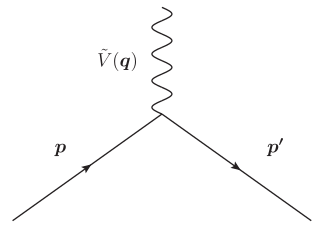
Recall the definition of transition matrix, we have: \begin{align*} &\bra{p'} i \hat{T} \ket{p} \\ =& -i\int dx_a \, dx_b \braket{p', T/2|x_a}K_1(x_a,T/2;x_b,-T/2) \braket{x_b|p,-T/2} \\ =& -i\int dx_a \, dx_b \, dt' \, dx' \, V(x') \times \\ &\, \psi_{p'}^*(x_a,T/2) K_0(x_a,T/2;x',t')K_0(x',t';x_b,-T/2) \psi_p(x_b,-T/2) \end{align*} Note here in the definition of transition matrix, \ket{p'} and \ket{p} are defined under Interaction Picture, but normally propagator works under Schrödinger picture, so we have to take account of that. And here we’ve inserted two sets of position eigen states which is the canonical way of using propagators, and we get wave functions. By integrating over x_a and x_b, we get wave function at (x',t').
Then the last thing is substituting wavefunction of momentum eigen states in to our expression: \begin{align*} &\bra{p'} i \hat{T} \ket{p} \\ =& -i\int dt' \, dx' \, V(x') \psi_{p'}^*(x',t') \psi_p(x',t') \\ =& -i\int dt' \, dx' \, V(x') \, \mathrm{e}^{i(\bm{p}-\bm{p'})x'-(E_p-E_{p'})t'} \\ =& -i(2\pi)\,\delta(E_p-E_{p'}) \int dx' V(x') \, \mathrm{e}^{-i\bm{q}x'} \\ =& -i(2\pi)\,\delta(E_p-E_{p'}) \tilde{V}(\bm{q}) \end{align*} Which is exactly the answer.