This is the final project of the subatomic physics online course hosted by MIT which I’ve attended this term. An easy but somehow interesting project. It’s basically the original version I submitted, with tiny adjustments.
With out further data selection Figure 1, the data is not significant comparing to the background. Around 125GeV, the data seems to be random distributed.
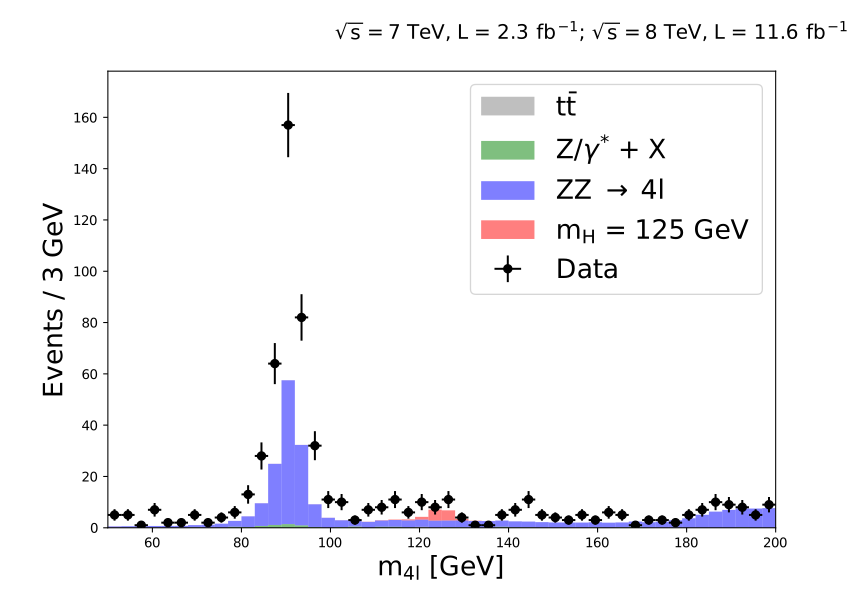
Basic Object Selection & Z candidates
After implying momentum & \eta cut, one should also filter out those events with wrong lepton pair, which does not satisfy charge conservation.
Then pick the first one among four leptons, pair it with one of, if not the only, other leptons which is its anti-particle counterpart. After this process, one or two pair(s) of Z boson candidates can be constructed. However, we should choose the one pair which among the pair there is one Z boson as close to on-shell as possible.
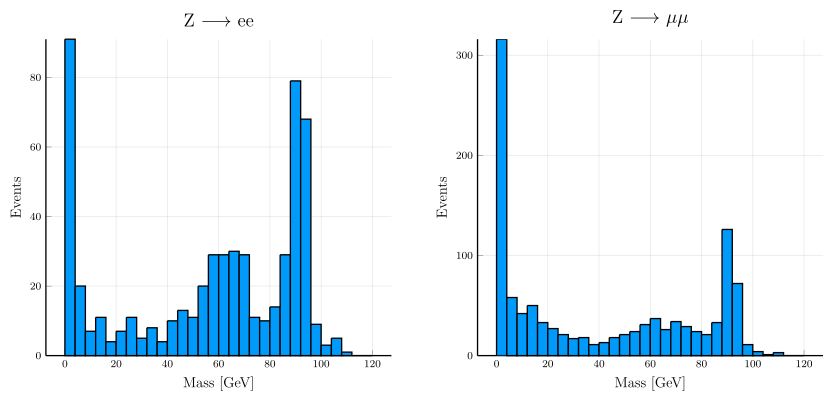
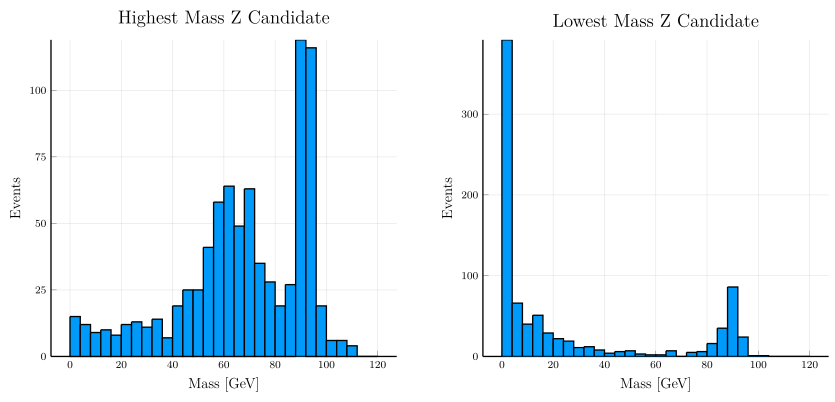
After constructing and choosing the best fitting Z boson pairs, one can draw the distribution of constructed Z boson mass, separating by decay flavor or maximum/minimum in the pair. This leads to Figure 2 (by flavor) and Figure 3 (by energy).
Find & apply the best simple cut
By selecting the MC events which m_{4l} fits between 119GeV and 131GeV, one can, for each event, construct a Z boson pair based on the method we have mentioned before. The constructed Z boson pair has two Z boson masses, one is Z_1, which is closer to m_Z (on-shell mass), comparing to the other one Z_2.
A cut confines m_{Z_1} and m_{Z_2} in a specific region on the (m_{Z_1},m_{Z_2}) plane. Four parameters are needed, implies that C_1 < m_{Z_1} < C_2,\; C_3 < m_{Z_2} < C_4, By sweeping through the parameter space, which is chosen to be 20-35, 95-115, 10-24, 45-68, the optimal combination is C = (26, 99, 14, 64).
By using C = (26, 99, 14, 64), among the 71190 MC events which passed the cut, 63157 events are H \to 4l events, the significance value is 2.341.
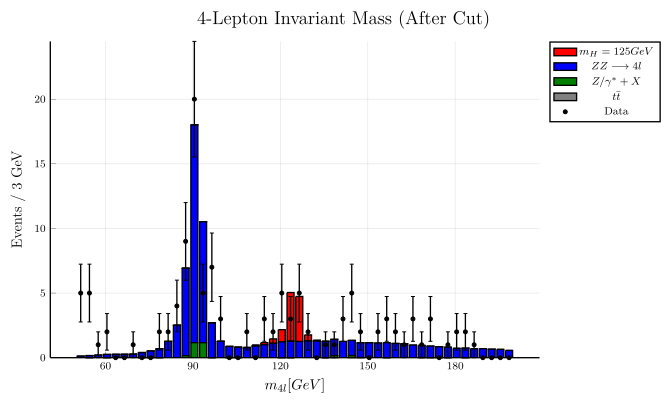
By applying this fine-tuned cut to the MC events and real data, one can improve the diagram of the distribution of m_{4l}, to find Higgs signal. The result is shown in Figure 4.
Filtering events by BDT classifier
The ML library used is EvoTrees.jl. Here we are using a decision tree with depth of 4, trained 200 rounds, the loss algorithm is Logarithmic Loss.
For training, we split the MC events satisfied previous constraints in half. Half of the events are used for training, and the other half are used to find the optimal threshold. With this configuration, 70312 MC events passed, with 62604 Higgs events among them, and the significance is 2.341.
Using BDT with Z boson masses as input features yielded a result similar to the rectangular cut method. This similarity is expected, the kinematics of H \to 4l and ZZ are overlapping, which means BDT, which can be seen as offering a more fine-tuned cutting boundary, still won’t be able to tell them apart. The BDT could potentially offer greater improvements if additional kinematic variables is included.
The result with BDT filtering is shown in Figure 5.
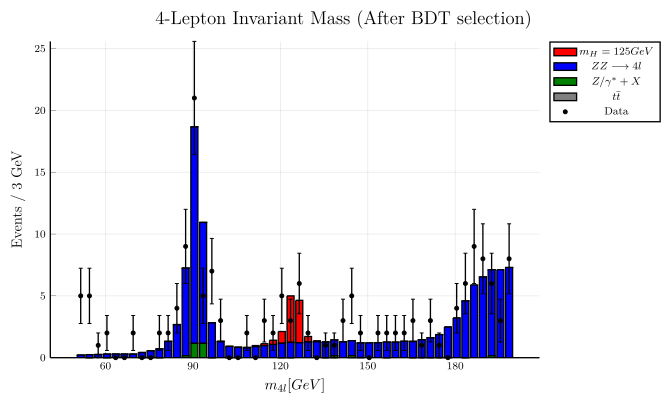
Through the whole data set we do see some differences between BDT and rectangular cut. BDT does not filter out much when m_{4l} is too large, but this does not affect our result about Higgs boson.
All Julia and LaTeX source code can be found at this repo.